https://play.google.com/store/apps/details?id=com.droidactor.hangul
In short. The seatback map shows the plane halfway to Seoul. The Wi-Fi costs extra, and you have already seen the movies. In a few hours every sign, menu and subway map around you will be written in Hangul.
That stretch of the flight is enough to learn the basics of reading it. Hangul was introduced in 1446 in a book called the Hunminjeongeum Haerye. It explains why each letter looks the way it does. Its afterword even promises that a quick learner gets it before the morning is over. Dotori Learn Hangul follows that book in six short steps. The lessons and their sounds are built into the app, so they work in airplane mode.
Six short steps, all open from the start
The home screen lists the whole course. Nothing is locked, there is no account, and there are no streaks to keep.
- The story of Hangul: King Sejong, 1443 and 1446, and how the Haerye was found
- Five basic consonants, each drawn from a speech organ
- Adding strokes: one more line for a stronger sound
- Heaven, earth and human: every vowel from three symbols
- Building syllable blocks, including final consonants
- Reading real words
Each step ends with a short multiple-choice quiz, and a mixed review draws from all six. Step 6 is the payoff for a trip. Its words include 택시 (taxi), 버스 (bus), 호텔 (hotel), 커피 (coffee) and 감사합니다 (thank you). The first four are loanwords, so once you can sound them out you already know what they mean.
Consonants are pictures of the mouth
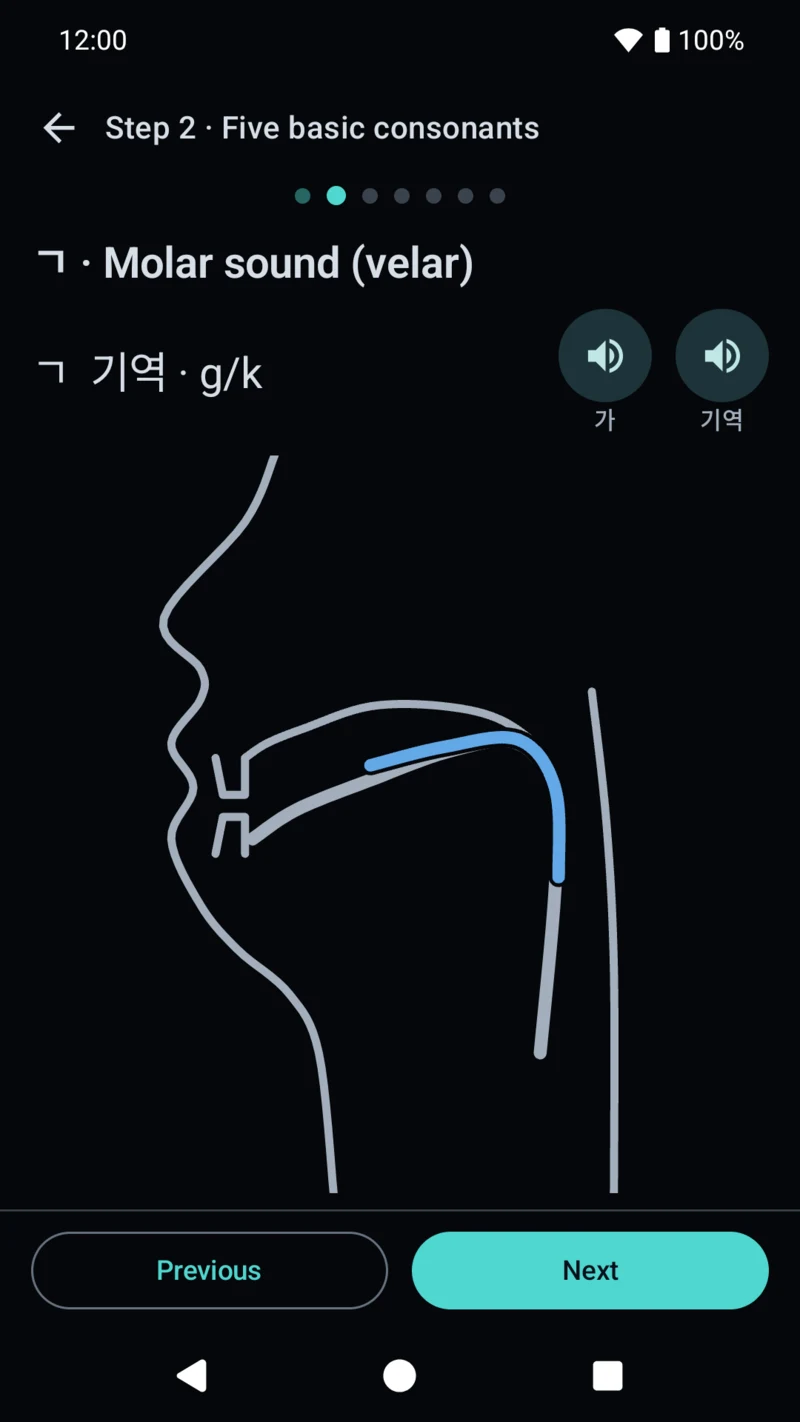
The Haerye says the five basic consonants copy the shape of the speech organs. ㄱ is the back of the tongue closing off the throat. ㄴ is the tongue tip touching the ridge behind the upper teeth. ㅁ is the mouth, ㅅ is a tooth, and ㅇ is the throat. In step 2 an animation turns the side view of a head into each letter. Two buttons play the sound with a vowel (가) and the letter's name (기역).
Step 3 adds strokes. A stronger sound gets one more line, so ㄱ becomes ㅋ and ㄴ becomes ㄷ and then ㅌ. Learn the five shapes and that rule, and most of the consonants follow.
Vowels are three symbols, syllables are squares
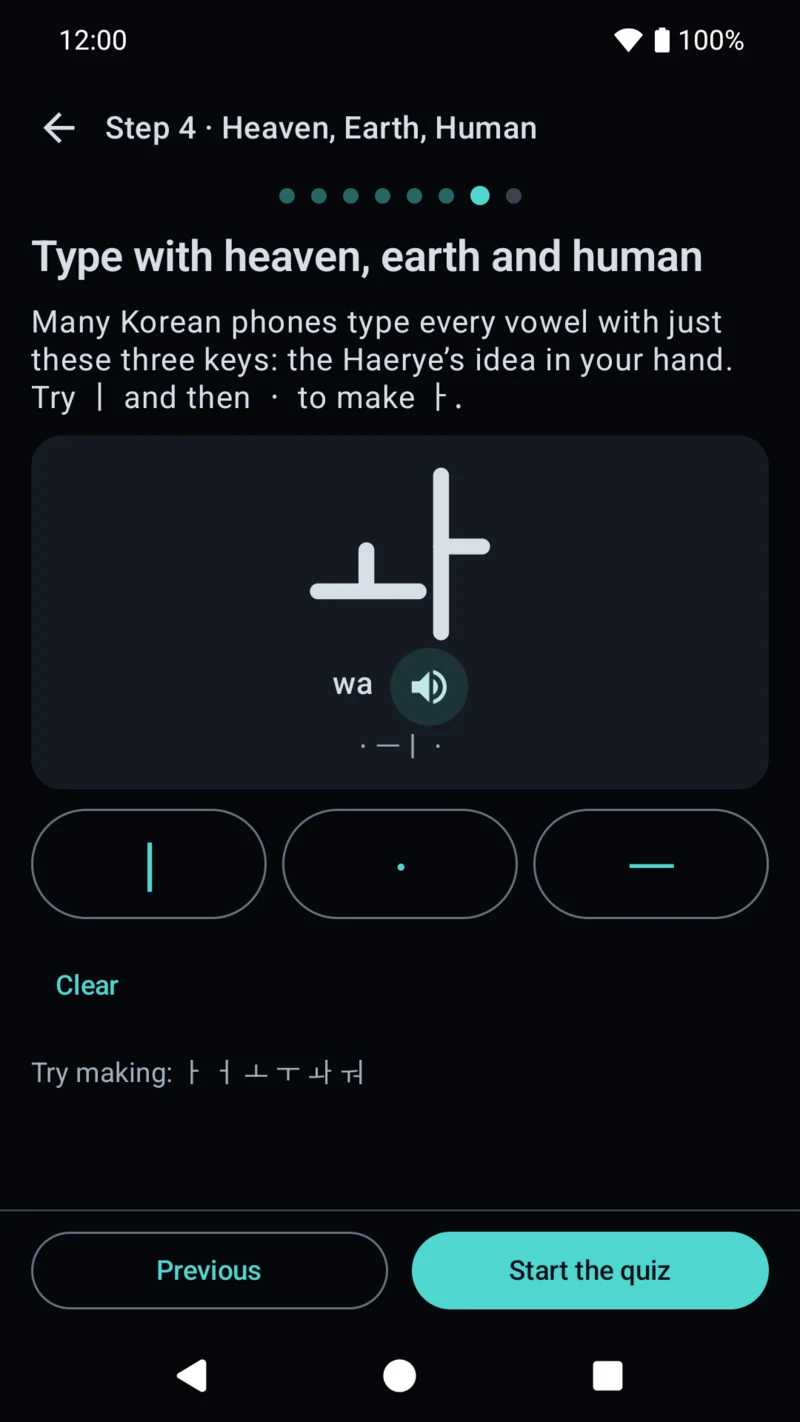
Step 4 builds every vowel from three symbols. A dot is heaven, a flat line is earth, and an upright line is a person. Put the dot to the right of ㅣ and you get ㅏ. Many Korean phones type vowels with just those three keys, and the app has the same keypad to try.
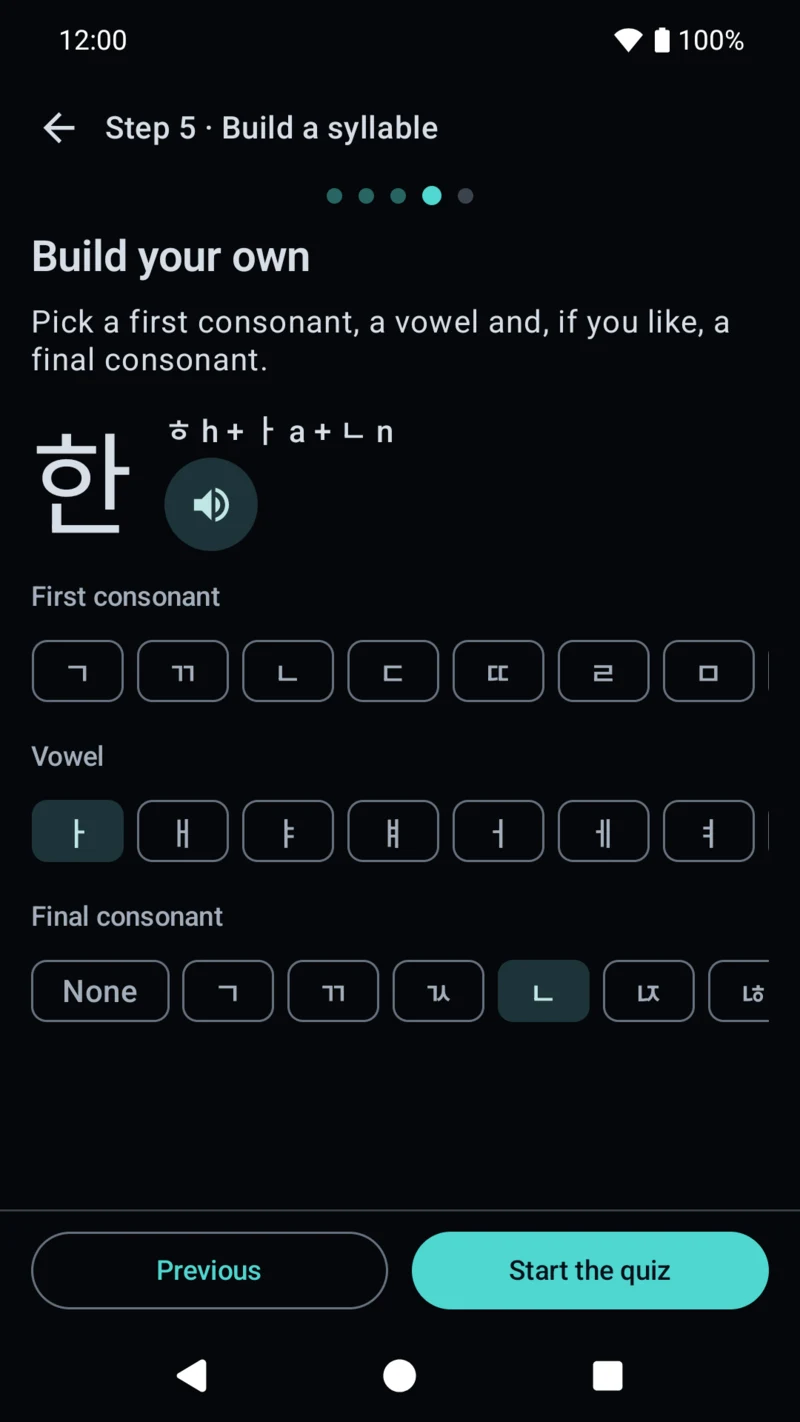
Step 5 stacks letters into the square blocks you see on signs. In the block builder, pick ㅎ, ㅏ and ㄴ and you get 한. Each letter's sound is shown, and a button plays the syllable.
Set it up before you board
The lessons need no connection, but two newer features rely on things your phone has to fetch first. Read Korean for me reads Korean that you write by hand or photograph. You pick what was read, and it plays aloud. Tap a word or syllable to split it into letters and open each letter's card.
- Install the app and open it once while you still have Wi-Fi.
- If you want handwriting reading, start it on the ground. It needs a one-time download of Google's Korean handwriting model, about 25 MB.
- Check that your phone has a Korean text-to-speech voice. Read Korean for me uses it, and the app shows where to install one if it is missing.
- In settings, pick the app language and a sound notation: dictionary style, IPA or romanization.
Choose from English, Korean, Japanese, Traditional Chinese, Vietnamese and Spanish. French, German, Italian, Portuguese and Hindi are available too. Select a language in the app or follow your phone's setting.
Know the limits too. The letter and word sounds are synthesized speech, not a native speaker's recording. The tracing pad shows how to write a letter and what your writing was read as. It does not grade it. Recognition can be wrong, especially for handwriting on paper. Nothing is read aloud until you pick it.
Wrap-up
Five mouth shapes, three vowel symbols and one square are the core of Hangul. The app teaches them offline in six steps and ends with words you will see on arrival.
Install it before your flight and set up handwriting while you have Wi-Fi. Then open step 2 once the seatbelt sign goes off.
Dotori Learn Hangul teaches Hangul from the 1446 Haerye in six short steps, with bundled sounds that play offline, a quiz for every step and real words such as taxi and hotel. More about Dotori Learn Hangul