https://play.google.com/store/apps/details?id=com.droidactor.hannum
In short. You learn that 3 is 삼, then hear someone count people with 세 instead. Dotori Learn Korean Numbers helps beginners work out which reading fits the situation. Choose a number and a counter, compare the readings and open the explanation. You can start with the expression you need, then practise its rule in a short lesson or quiz.
Dotori Learn Korean NumbersLearn Korean numbers through meaning, counters and short practice.
The same written counter can have different meanings
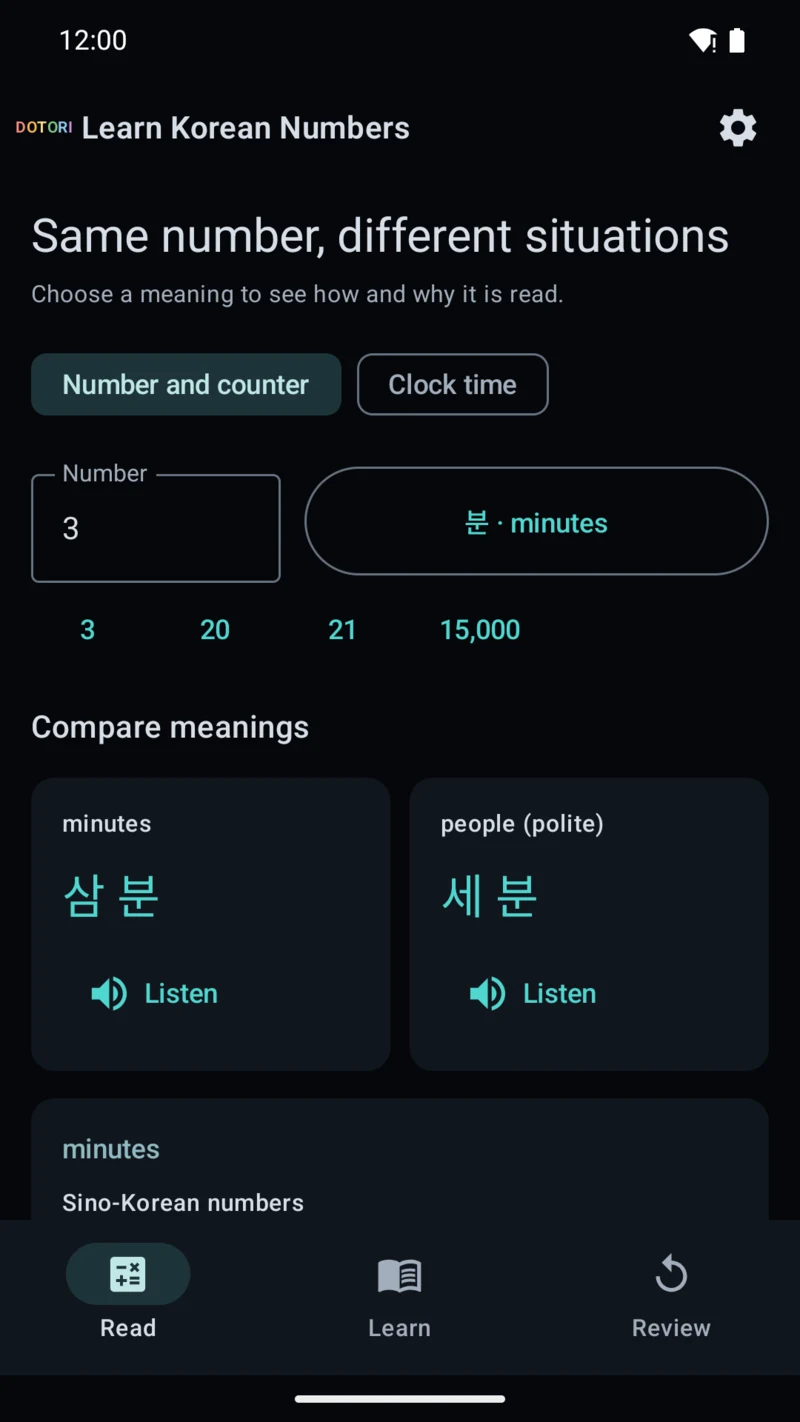
Three minutes is 삼 분, or sam bun. Three people, when counted politely with 분, is 세 분, or se bun. The written number and counter look the same. The meaning tells you which number system to use. The app places these two expressions side by side. Each has a button that explains the reading.
| Situation | Expression | Reading |
|---|---|---|
| Minutes of waiting | 3분 | 삼 분 — sam bun |
| People, counted politely | 3분 | 세 분 — se bun |
| The hour on a clock | 3시 | 세 시 — se si |
| Counting animals | 3마리 | 세 마리 — se mari |
This is why learning two lists of numbers is only the beginning. A counter is the word used with a number to count something. Learn the number together with that word and its meaning to get an expression you can use. The comparison screen also covers other easily confused meanings. For example, 번 appears in both numbered items and repetitions.
Clock time brings both systems into one expression
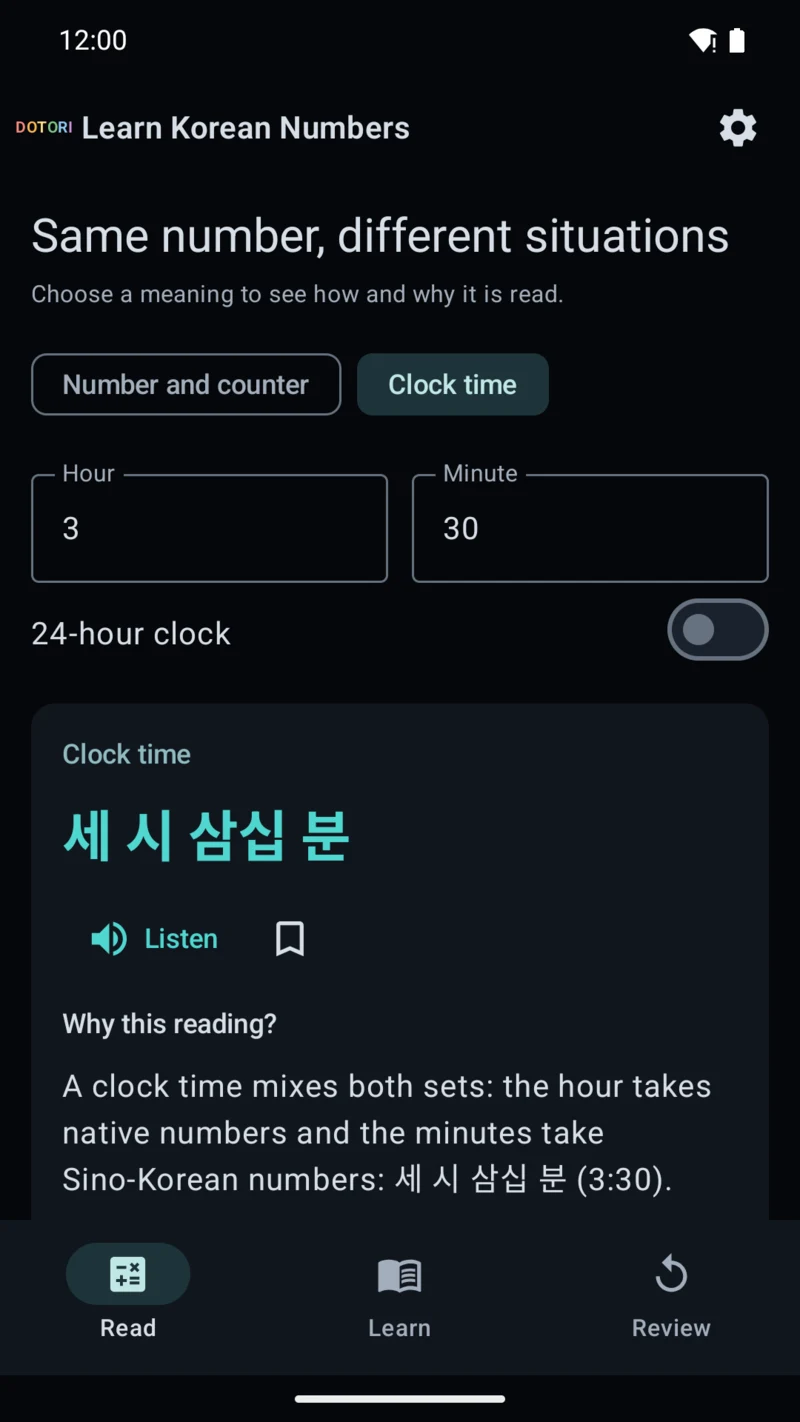
Three oh three is 세 시 삼 분. The hour uses a native Korean number. The minutes use a Sino-Korean number. Open the clock view and change the hours and minutes to see the whole expression. It is a useful example when you know both number lists but hesitate when they appear together.
Native numbers also change before counters. 셋 becomes 세 in 세 마리, for example. See the result, then check its explanation to connect the form with its rule. Selected examples include dictionary-style pronunciation, IPA and romanization as reading aids.
Go from a comparison to lessons and review
Seven lessons cover both number systems, ten-thousand grouping and native numbers. They also cover forms before counters, everyday counters, meaning differences, time and age. They are all open from the start. Look up an expression first and return to its lesson when you want to understand the pattern.
Context quizzes ask you to choose the reading that fits a situation. Review the rules you missed and save expressions you want to remember. Learning records and saved expressions stay on your device. Lesson examples include bundled Korean audio. Other inputs use your device's Korean voice when one is available.
Choose your explanation language in the app’s settings. Korean expressions stay visible while explanations use your chosen language. The app includes banner advertising. Lesson material and example audio are bundled. Advertising, privacy options and device voice services may need a connection.
Start with 분 in the reading screen and compare three minutes with three people counted politely.
Watch the English app demo to see these screens in use.
Dotori Learn Korean Numbers lets you compare readings side by side, see the rule and practise it in context. More about Dotori Learn Korean Numbers